Key Takeaways (TL;DR):
- For 4K gaming in 2026-2027, a graphics card at the level of GeForce RTX 5070 Ti or higher with DLSS 4.0 support is necessary.
- Processors with a large L3 cache (like AMD Ryzen with 3D V-Cache) or high single-core performance (Intel) are critical for games on Unreal Engine 5.
- The minimum RAM standard is 32 GB of DDR5 with a frequency of 6400 MHz. A smaller amount or slower speed will cause micro-stuttering in new projects.
- Investing in a Z890/X870 chipset motherboard and a 1000-1200W power supply (ATX 3.1 standard) is key to future upgrades without replacing the entire platform.
| Purpose | Recommended Graphics Card | Processor | Approximate Budget |
|---|---|---|---|
| Full HD (1080p) / Esports | NVIDIA GeForce RTX 5060 12 GB | Intel Core Ultra 5 245H / AMD Ryzen 5 9600X | 45,000 - 55,000 UAH |
| 2K (1440p) / Optimal Gaming | NVIDIA GeForce RTX 5070 Ti 16 GB | Intel Core Ultra 7 265K / AMD Ryzen 7 9700X | 75,000 - 90,000 UAH |
| 4K (2160p) / Ultimate Gaming | NVIDIA GeForce RTX 5080 20 GB | Intel Core Ultra 9 285K / AMD Ryzen 9 9900X3D | 120,000 - 160,000 UAH |
GPU Domination: Blackwell and RDNA 4 as the Foundation for Unreal Engine 5
- NVIDIA RTX 50-series: The focus is on increasing the number of third-generation RT cores and fifth-generation Tensor cores. This provides a performance boost in path tracing tasks of up to 70% compared to the RTX 40 series. DLSS 4.0 technology with advanced frame generation becomes mandatory for 4K gaming.
- AMD Radeon RX 8000-series: AMD has focused on increasing Infinity Cache and improving the architecture of the computing units themselves. FSR 4.0 technology shows competitive results, but still lags behind NVIDIA's solutions in Path Tracing tasks.
The choice of a graphics card depends directly on your monitor. For 1440p at 144 Hz, the optimal choice would be the RTX 5070 Ti. For uncompromising 4K gaming, you should look towards the RTX 5080 or flagship AMD solutions.

Processor Parity: Intel Core Ultra 200 vs. AMD Ryzen 9000
In 2026, the processor is not just a computing core, but the conductor of the entire system. It is responsible for preparing frames for the graphics card, streaming, and background processes. The wrong CPU choice will create a bottleneck, and your powerful graphics card will be idle. Imagine putting a Formula 1 car engine on a chassis with regular city tires — you will never realize its potential. Here, the 'tires' are your processor.
Current processor lineups for 2026:
| Platform | Architecture | Key Advantage | Recommendation |
|---|---|---|---|
| Intel | Arrow Lake (Core Ultra 200) | High single-core clock speed, efficient E-cores for background tasks. | For users who value maximum out-of-the-box gaming performance. |
| AMD | Zen 5 (Ryzen 9000) | Huge L3 cache (especially in X3D versions), high energy efficiency. | For enthusiasts and gamers playing projects sensitive to cache size (simulators, strategies). |
For systems with an RTX 5080/5090, the optimal choices would be the Intel Core Ultra 9 285K or AMD Ryzen 9 9900X3D. For more balanced builds with an RTX 5070 Ti, a Core Ultra 7 265K or Ryzen 7 9700X is sufficient. It is important to ensure quality cooling, as flagship models can consume over 250W under load.

Building a Future-Proof PC in 2026: Pros and Cons
Advantages
- ✔Maximum performance in current and future games for the next 3-4 years.
- ✔Access to cutting-edge technologies: DLSS 4.0 Frame Generation, hardware-accelerated AI, path tracing.
- ✔High resale value of components on the secondary market after a few years.
- ✔Comfortable gameplay at 4K resolution without compromising on graphics settings.
Disadvantages
- ✖High initial investment cost, especially for flagship components.
- ✖Potential issues with 'teething problems' in drivers and BIOS at the launch of new platforms.
- ✖Increased requirements for system cooling and power supply.
Performance Ecosystem: DDR5, PCIe 5.0, and ATX 3.1
- RAM: The DDR5 standard has become mainstream. For a 2026 gaming system, a 32 GB kit with a frequency of at least 6400 MHz and low timings (e.g., CL32) is necessary. For work tasks and streaming, consider 64 GB.
- Storage: SSDs with a PCIe 5.0 interface provide read/write speeds of up to 14,000 MB/s. This is critically important for games with DirectStorage technology, which allows the graphics card to load data directly from the drive, minimizing load times and eliminating on-the-fly texture streaming.
- Motherboard: Choose models based on Intel Z890 or AMD X870/X870E chipsets. Key parameters: a powerful power delivery system (VRM) with 16+ phases, M.2 PCIe 5.0 slots, and support for high-frequency memory.
- Power Supply: New graphics cards and processors are extremely demanding on power. An ATX 3.1 standard PSU with a native 12V-2x6 connector is mandatory. The recommended wattage for systems with an RTX 5070 Ti is 1000W, and for an RTX 5080/5090, at least 1200W.
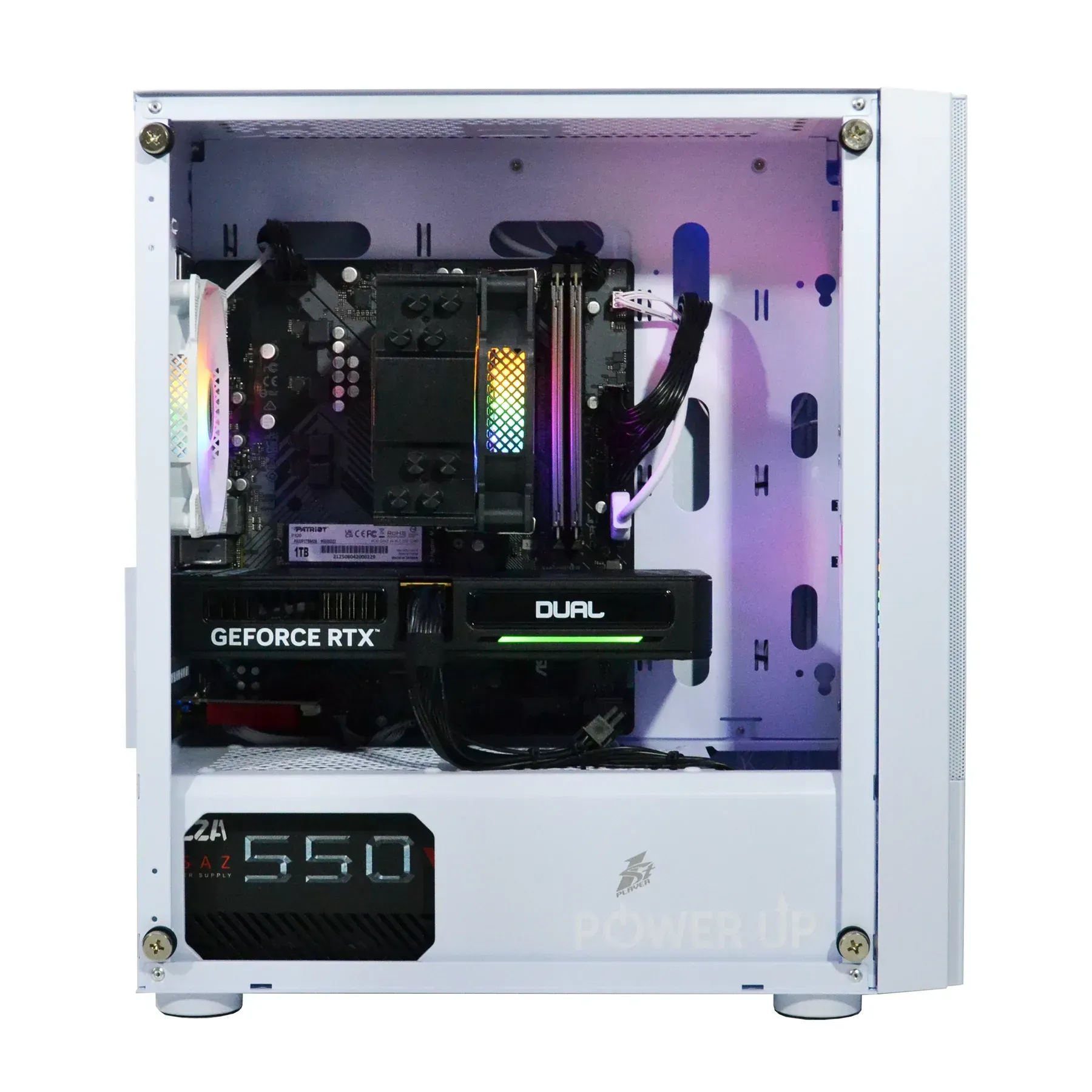
Expected Performance: 4K Benchmarks
| Game | Settings | DLSS 4.0 (Mode) | Average FPS |
|---|---|---|---|
| Cyberpunk 2077 (Phantom Liberty) | Ultra, Path Tracing ON | Performance + Frame Generation | ~110 FPS |
| Counter-Strike 2 | Maximum, Reflex ON | Off | ~450 FPS |
| GTA VI (projection) | High-Ultra, RT ON | Quality + Frame Generation | ~80-90 FPS |
These numbers clearly show that a modern gaming PC is capable of providing smooth gameplay even in the most demanding projects. You can always find more information about the capabilities of new GPUs on the official NVIDIA website.

Algorithm for Selecting a Balanced PC in 2026
This step-by-step guide will help you avoid bottlenecks and build a system where every component works at 100% of its efficiency. We will go from defining the goal to choosing the power supply.
Step 1: Defining the Goal: Resolution and FPS
Clearly define which monitor you will be playing on. 1440p @ 144 Hz or 4K @ 120 Hz? The answer to this question is the starting point that determines 70% of the budget and the choice of the graphics card. It's not worth overpaying for an RTX 5090 if you play on a Full HD monitor.
Step 2: Choosing the Graphics Card
The graphics card is the heart of a gaming PC. Based on the goal from the first step, choose the GPU. For 1440p - RTX 5070 / 5070 Ti. For 4K - RTX 5080 and above. It is the GPU's performance that dictates how powerful a processor we will need.
Step 3: Matching the Processor to the Graphics Card
Now we select a CPU that can 'feed' the graphics card with data. Use the rule: for an RTX 5070 Ti, a Core Ultra 7 / Ryzen 7 is sufficient. For an RTX 5080/5090, a Core Ultra 9 / Ryzen 9 is necessary. This prevents a situation where the GPU is waiting for frames from a slow CPU.
Step 4: Selecting the Platform and Power Supply
Based on the chosen CPU+GPU combination, we select the rest. A motherboard on Z890/X870 with a good VRM, 32 GB of fast DDR5-6400+, an M.2 PCIe 5.0 SSD, and a quality ATX 3.1 power supply with a 20-25% power overhead. For example, for a system consuming 750W, get a 1000W PSU. This will ensure stability and quiet operation.
Frequently Asked Questions (FAQ)
Is it worth building a PC with DDR4 now?
Absolutely not. In 2026, DDR4 is an obsolete standard. New Intel and AMD platforms do not support it, and modern games are already utilizing the bandwidth of DDR5. Building on DDR4 is a step into the past.
Is a PCIe 5.0 SSD really necessary for gaming?
Not for all games yet, but it's an investment in the future. Games with DirectStorage technology, which will become the standard in 2026-2027, will show a significant increase in loading speed specifically on PCIe 5.0 drives. If the budget allows, it's a mandatory purchase.
Is an 850W power supply enough for an RTX 5070 Ti?
Technically, it might be enough, but we strongly recommend getting one with a reserve — a minimum of 1000W of the ATX 3.1 standard. New graphics cards have high peak power loads (transients), and a quality PSU with power overhead will ensure system stability and protect the components.
Air cooling or AIO for new processors?
For processors at the level of Core Ultra 5 / Ryzen 5, a top-tier air cooler is sufficient. For Core Ultra 7 / Ryzen 7 and above, a 360mm All-In-One (AIO) liquid cooling system is strongly recommended to unlock their full potential and avoid throttling.