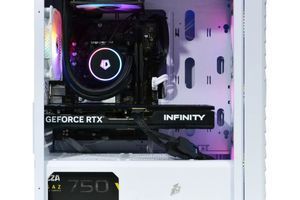
Every gaming PC has temporary working storage, commonly known as RAM (Random Access Memory). For many years, RAM has been one of the most vital components for the proper functioning of any computing device.
Over time, the technology behind memory has undergone significant changes, leading to a shift in terminology. This transformation is most evident in the terms used to define the speed of memory modules.
This article explains memory speed in simple terms and how different metrics affect each other.
Memory Speed – Various Definitions
Let’s take a closer look at the key terms describing how a gaming computer or other types of PCs handle memory speed.
Clock Frequency
Clock cycles indicate the operating speed of any computer component. This parameter refers to the number of electronic signal oscillations per second. This frequency is measured in Hertz (Hz), with MHz and GHz representing millions and billions of cycles, respectively. CPU speeds are measured in these units.
In early computer systems, one data packet was sent per clock cycle. Therefore, it was logical to define memory frequency as its speed. If a module had a clock frequency of 100 MHz, it meant it could send data 100 million times per second. This 1-to-1 ratio was standard until the early 21st century.
However, memory bandwidth began to grow rapidly with the introduction of Intel's multi-threading technologies, dual-core chips, and clock frequencies exceeding 1 GHz.
To avoid bottlenecks, dual-channel memory controllers and new memory types were introduced. DDR (Double Data Rate) memory became the industry standard, allowing the transfer of two data packets per clock cycle.
Transfer Speed (MT/s)
The introduction of the "Megatransfers per second" (MT/s) metric allowed for more accurate reporting of performance. MT/s is calculated by taking the actual clock frequency and multiplying it by the number of transfers per cycle.
For example, DDR5 6400 MHz memory often shows this value in motherboard BIOS settings, but the actual frequency is 3200 MHz. By multiplying this by 2 transfers per cycle, we get the real value of 6400 MT/s.
Data Transfer Rate
Some manufacturers use Mbps (megabits per second) to describe speed. This approach, favored by SK Hynix and Samsung, is useful for comparing various PC metrics:
- Storage performance is measured in MB/s and GB/s;
- Wired networks use 10, 100, 1000 Mbps and Gbps;
- Wi-Fi speeds have also reached the Gbps level.
To determine the total data transfer rate, we multiply the transfer speed by the number of lines (bits). Standard consumer DDR5 memory has 64 bits. Thus, the theoretical bandwidth is 6400 x 64 = 409,600 Mbps.
Naming Standards
JEDEC is the organization that sets standards for computer memory. The naming convention usually includes the memory type and speed rating. For instance, DDR5-6400 signifies 5th generation Double Data Rate memory with a 6400 MT/s rating.
Another standard naming convention is PC5-51200, where the transfer rate is multiplied by the number of bytes sent per transfer.
Additional Memory Speed Criteria
Other factors also impact the performance of a computer's RAM.
Latency (Timings)
Memory timing is the time elapsed between a request for data and when that data becomes available. As transfer speeds and frequencies increase, timings generally increase as well. However, the actual latency in nanoseconds remains relatively stable.
| Speed | Timings | Ratio | Real-time Latency |
| 5600 MT/s | CL46 | ~121.7 | ~16.43 ns |
| 6400 MT/s | CL52 | ~123.1 | ~16.25 ns |
Overclocking
Beyond JEDEC standards, many manufacturers use Intel XMP or AMD EXPO profiles to tighten timings and increase speed. While this boosts performance, it can sometimes lead to instability due to the increased load on the memory modules.
Memory Channels
To keep up with high core counts (up to 192 cores), modern platforms use multiple memory channels to prevent bandwidth bottlenecks. The memory controller, now integrated into the CPU, determines the number of supported channels.
| Manufacturer | Processor Type | Cores/Threads | Memory Channels |
| AMD | Ryzen™ 9000 | 16/32 | 2 |
| AMD | Threadripper™ 9000 | 64/128 | 4 |
| AMD | EPYC™ 9005 | 192/384 | 12 |
| Intel | Core™ Ultra 200 | 24/24 | 2 |
| Intel | Xeon® W-3500 | 60/120 | 8 |
Theoretical bandwidth calculation for an AMD Threadripper PRO 9000WX: 6400 MT/s x 64 bits x 8 channels = 3,276,800 Mbps. Note that this is a theoretical maximum; real-world performance is typically lower.