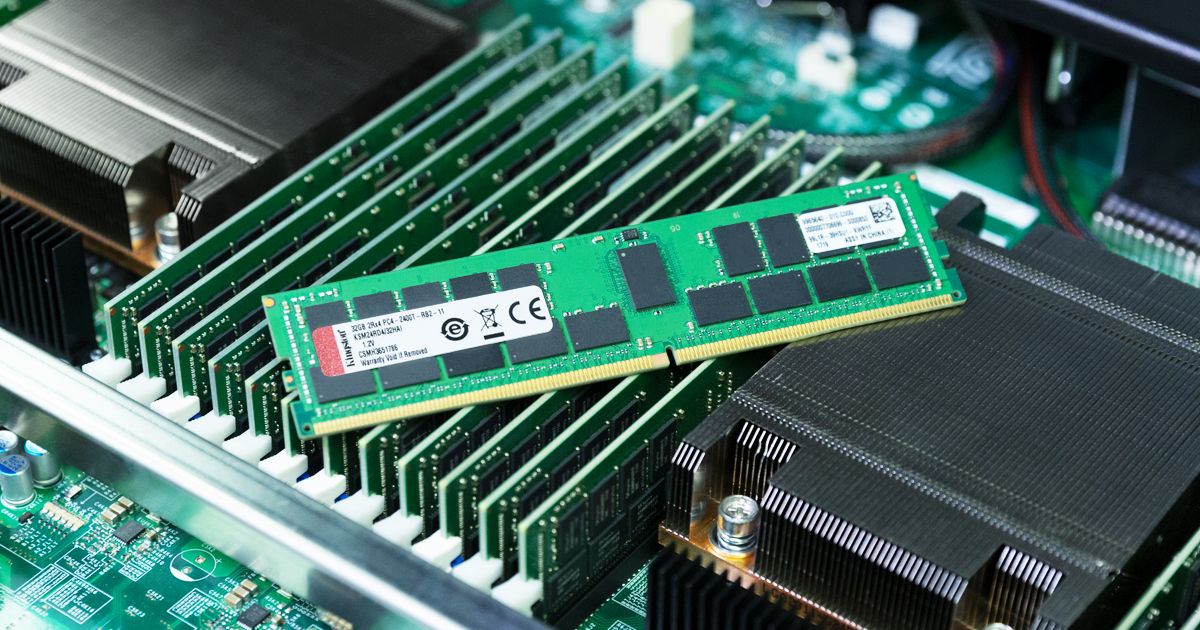
In high-performance computing, engineering tasks, video and image rendering, machine learning, and critical big data processing, system stability is just as vital as speed. Memory is the foundation that directly affects operational reliability under these workloads.
What is ECC Registered Memory (ECC RDIMM)?
“ECC” stands for Error-Correcting Code.
This type of RAM is equipped with additional circuitry that can detect and automatically correct certain data errors during read and write operations. ECC Registered memory implements single-bit error correction (correcting one "flipped" or incorrect bit among many in a data stream). While multi-bit errors may not always be corrected instantly, the system is at least alerted to take corrective action. In standard, non-ECC memory, such errors typically go undetected and uncorrected. Over time, this leads to error accumulation, resulting in corrupted calculations, software crashes, and the need for system reboots, which can be time-consuming or impossible without interrupting critical computations.
ECC memory adds “check bits” alongside actual data bits in each memory module. When the memory controller receives data, it calculates a checksum-like code, compares it with the check bits, and if a mismatch is found, corrects the single-bit error on the fly without interrupting the task. This process happens without software intervention. Essentially, ECC memory “self-heals” random bit flips caused by:
- Electrical noise;
- High-energy cosmic radiation particles;
- Memory cell aging;
- Voltage spikes.
The term “Registered” refers to the fact that these memory modules contain a register (buffer) between the memory cells and the controller. Addresses and commands pass through the buffer, which re-clocks them rather than the controller driving all memory chips directly. This is crucial for multi-module systems where signals become complex. By buffering signals, ECC RDIMM reduces the electrical load on the controller, improves timing, and allows for more modules or higher capacity per module to be reliably recognized. While buffering adds a small latency (5-10%), it is a beneficial trade-off for professional workloads requiring stability, scalability, and data integrity.
Key Differences: ECC Registered vs. Non-ECC Memory
|
Criteria |
Non-ECC Memory |
ECC RDIMM |
|
Purpose |
Daily tasks and general use |
Professional use: complex computing, graphics rendering, engineering, AI, etc. |
|
Reliability |
Standard; ultra-reliability is not a requirement |
High reliability over a predictable lifespan |
|
Speed |
5-10% faster than ECC Registered |
Slower due to additional technological processes |
|
Cost |
Mass-market level |
Significantly more expensive (ROI through increased stability) |
|
Compatibility |
Standard PCs and laptops. ECC RDIMM will not work without specific support |
Only high-end server-class platforms like Intel Xeon or AMD EPYC |
|
Capacity per stick (GB) |
Max 128 |
256-512 |
|
Stability |
Crashes possible as bit flips are ignored |
Crashes are rare; most bit flips are corrected instantly |
Why ECC Registered is Critical in Professional Environments
Servers are subject to constant, intensive workloads such as:
- Video and graphics rendering;
- Long-duration computational simulations;
- Training AI models;
- Processing large datasets;
- Maintaining 24/7 critical services.
In these environments, even an infrequent single-bit error can cascade, leading to incorrect results or complete system failure.
Conclusion
ECC Registered memory should be used wherever there are ultra-high requirements for reliability and data integrity. For systems handling long-term rendering, scientific computing, machine learning, or critical infrastructure, it is a primary requirement. Opting out might save money initially, but the cost of lost data and downtime far outweighs the initial savings.